Understanding the Bid-Ask Spread: What It Is and Why It Matters
Every time you buy or sell a stock, bond, or other security, you encounter the bid-ask spread. This difference represents a hidden cost of trading that can significantly impact your returns, especially if you trade frequently or invest in less popular securities.
Understanding how the bid-ask spread works helps you make smarter trading decisions and keep more money in your pocket. Whether you're buying your first stock or managing a diverse portfolio, knowing this concept is essential for successful investing.
The bid-ask spread is a fundamental component of market microstructure, directly affecting how orders execute and the costs traders face. Understanding this cost helps you optimize order execution strategy and choose appropriate trading venues.
What Is the Bid-Ask Spread?
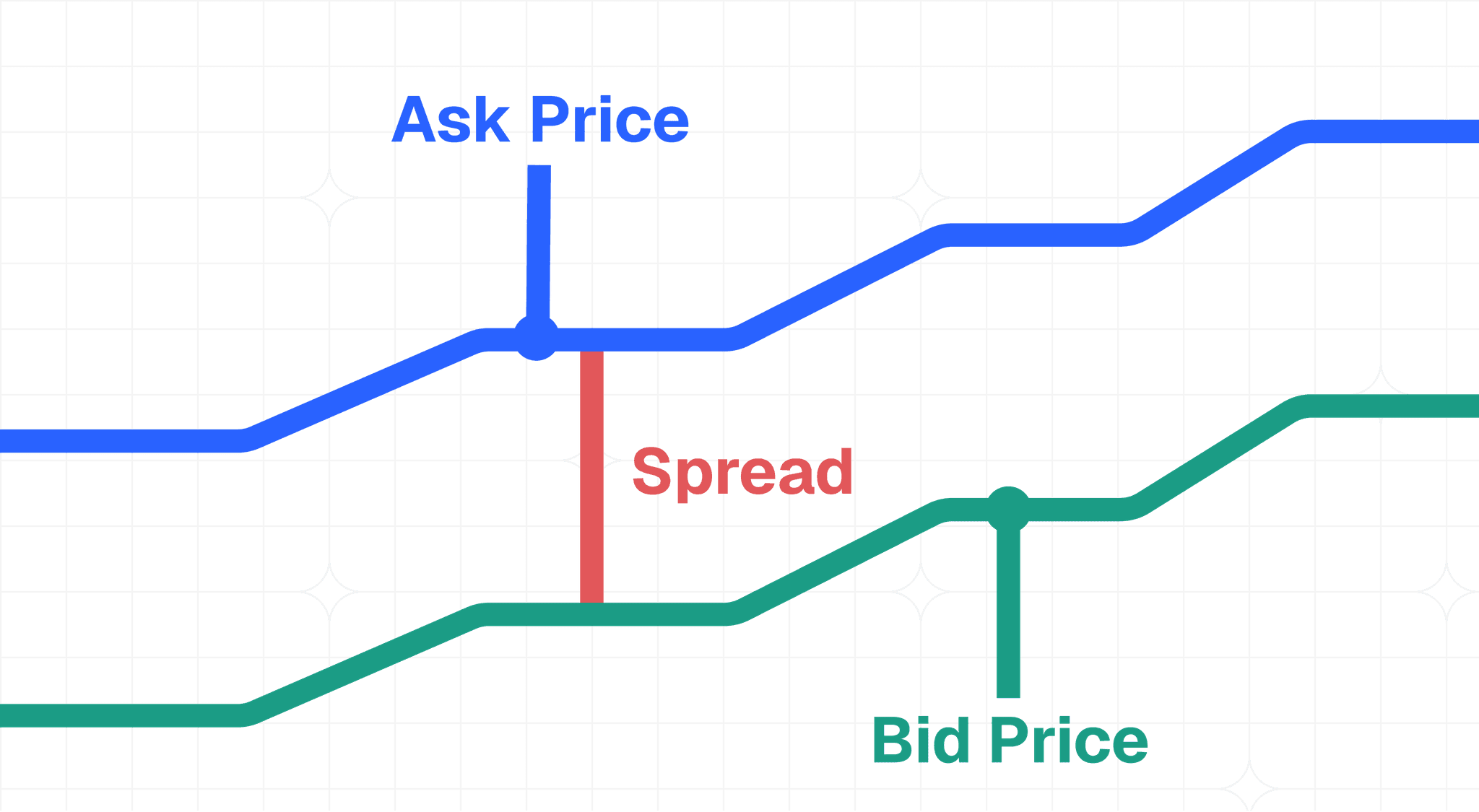
The bid-ask spread is the gap between two prices in the market. The bid price is the highest amount a buyer is currently willing to pay for a security. The ask price (also called the offer price) is the lowest amount a seller is currently willing to accept. The spread is simply the difference between these two prices.
Think of it this way: Imagine you're selling a used car. A buyer offers you $10,000 (the bid), but you want $10,500 (the ask). The $500 difference is the spread. In the stock market, this spread exists for every security at every moment the market is open.
When you buy a stock, you pay the ask price. When you sell, you receive the bid price. This means the spread represents an immediate cost—the moment you buy a stock, you're already "down" by the amount of the spread because you'd have to sell at a lower price.
How to Calculate the Bid-Ask Spread
Calculating the bid-ask spread is straightforward, and it can be expressed as either a dollar amount or a percentage.
Dollar Spread Formula:
Example:
- Ask Price: $50.10
- Bid Price: $50.00
- Spread = $50.10 - $50.00 = $0.10
Percentage Spread Formula:
Example:
- Ask Price: $50.10
- Bid Price: $50.00
- Spread % = (($50.10 - $50.00) / $50.10) × 100% = 0.20%
The percentage spread is more useful for comparing costs across different securities since a $0.10 spread means different things for a $10 stock vs. a $100 stock.
Why the Bid-Ask Spread Matters
The bid-ask spread directly affects your investment returns, particularly in several key ways.
Trading Costs: Every time you buy and sell, you lose the spread amount. If you buy a stock at $50.10 (ask) and immediately sell at $50.00 (bid), you've lost $0.10 per share—a 0.20% loss before the stock even moves. For active traders making dozens or hundreds of trades, these costs accumulate rapidly.
Breakeven Point: Your investment must increase by at least the spread percentage just to break even. A stock with a 1% spread needs to appreciate by 1% before you profit, while a stock with a 0.1% spread only needs to rise 0.1%. This difference significantly impacts short-term trading strategies.
Portfolio Performance: Trading costs, including bid-ask spreads, can reduce annual returns by 1-2% for active investors. Over decades, this compounds into substantial wealth differences.
Factors That Affect the Bid-Ask Spread
Several factors influence how wide or narrow a spread becomes, and understanding these helps you predict and manage trading costs.
Liquidity
Liquidity is the primary driver of spread size. Highly liquid securities like Apple (AAPL) or Microsoft (MSFT) typically have spreads of just $0.01 (one cent) because millions of shares trade daily. Less liquid stocks might have spreads of $0.50 or more because fewer buyers and sellers are active.
Example: A popular large-cap stock might show a bid of $150.00 and an ask of $150.01 (0.007% spread), while a small-cap stock could show a bid of $5.00 and an ask of $5.50 (10% spread).
Volatility
When markets are uncertain or a specific stock experiences unusual price swings, market makers widen spreads to protect themselves from risk. During market crashes or major news events, spreads can expand dramatically as uncertainty increases. These liquidity providers play a crucial role in maintaining orderly markets across different trading venues.
Trading Volume
Securities with higher trading volume generally have tighter spreads because more competition exists among buyers and sellers. The stocks trade billions of dollars daily and maintain extremely tight spreads, while obscure penny stocks might trade only a few thousand dollars daily with wide spreads.
Time of Day
Spreads typically widen at market open (9:30 AM ET) and close (4:00 PM ET) when volatility increases. The narrowest spreads usually occur during mid-day hours (11:00 AM - 2:00 PM ET) when markets are calmer and volume is stable. Understanding this pattern helps you time trades for better prices.
Security Type
Different security types have characteristically different spreads. U.S. Treasury bonds have extremely tight spreads due to their liquidity and government backing. Corporate bonds have wider spreads reflecting lower liquidity. Options and other derivatives can have very wide spreads, sometimes exceeding 5% of the security's value.
How to Minimize Bid-Ask Spread Costs
While you can't eliminate spread costs entirely, several strategies help minimize their impact on your returns.
Trade Liquid Securities: Focus on stocks and with high daily volume. Large-cap stocks and popular ETFs like SPY or VOO have minimal spreads. Check the average daily volume—securities with over 1 million shares traded daily typically offer good liquidity.
Use Limit Orders: Instead of that execute immediately at the ask (when buying) or bid (when selling), use that specify your price. You might place a limit order between the bid and ask, potentially saving money if the market moves in your favor. Learn more about different order types and how they interact with the bid-ask spread.
Avoid Trading at Open and Close: Execute trades during mid-day hours (11:00 AM - 2:00 PM ET) when spreads are typically tightest. This is particularly important for less liquid securities where timing can save 0.5% or more.
Consider Trading Costs in Your Strategy: If you're a long-term investor making occasional trades, spreads matter less than for day traders. A 0.2% spread cost is negligible for an investment you'll hold for years but devastating for a trade you plan to exit in hours. Match your trading frequency to securities with appropriate spread costs.
The Bid-Ask Spread vs. Brokerage Commissions
Many investors confuse the bid-ask spread with brokerage commissions, but they're distinct costs that both impact your returns.
Brokerage commissions are fees charged by your broker for executing trades. Most major U.S. brokers (Fidelity, Charles Schwab, E*TRADE, Robinhood) eliminated stock trading commissions in 2019, so most investors pay $0 in commissions for stock trades.
The bid-ask spread is an implicit cost that exists regardless of your broker. You can't avoid it, and it doesn't appear on your trade confirmation as a separate line item. This makes spread costs less visible but equally important.
Combined Impact: Even with zero-commission trading, you still pay the spread. A stock with a 0.5% spread costs you 0.5% to trade, making it more expensive than a stock with 0.01% spread and a $5 commission if you're trading more than $1,000 worth.
Real-World Examples
Understanding spreads through concrete examples helps illustrate their practical impact on different trading scenarios.
Example 1: Large-Cap Stock (Low Spread)
You want to buy 100 shares of Apple (AAPL):
- Bid: $180.50
- Ask: $180.51
- Spread: $0.01 (0.006%)
Trade Calculation:
- Cost to buy: 100 × $180.51 = $18,051
- Immediate sale value: 100 × $180.50 = $18,050
- Immediate loss from spread: $1
The spread cost is minimal—just $1 or 0.006% of your investment. This is negligible for most investment strategies.
Example 2: Small-Cap Stock (Medium Spread)
You want to buy 100 shares of a small-cap company:
- Bid: $12.00
- Ask: $12.25
- Spread: $0.25 (2.04%)
Trade Calculation:
- Cost to buy: 100 × $12.25 = $1,225
- Immediate sale value: 100 × $12.00 = $1,200
- Immediate loss from spread: $25
The spread cost is $25 or 2.04% of your investment. The stock must increase by more than 2.04% just for you to break even, making short-term trades challenging.
Example 3: Round-Trip Trade Impact
You buy and then sell 1,000 shares of a stock:
Initial Purchase:
- Ask: $50.10
- Cost: 1,000 × $50.10 = $50,100
Subsequent Sale (price unchanged):
- Bid: $50.00
- Revenue: 1,000 × $50.00 = $50,000
Total Loss: $100 (0.20% round-trip cost)
Even though the stock price didn't change, you lost $100 to the spread. Active traders making multiple round-trip trades daily can lose substantial amounts to spreads even on winning days.
Key Takeaways
The bid-ask spread is an unavoidable cost of trading that directly reduces your investment returns. Understanding how it works and what influences its size helps you make more cost-effective trading decisions.
Focus on liquid securities with high trading volumes to minimize spread costs. Large-cap stocks and popular ETFs offer the tightest spreads and lowest trading costs. Time your trades for mid-day hours when spreads are typically narrowest, and use limit orders to potentially improve your execution prices.
For long-term investors making occasional trades, spreads have minimal impact on overall returns. For active traders, however, spread costs can accumulate rapidly and significantly erode profitability. Match your trading frequency and strategy to securities with appropriate spread characteristics.
Remember: Even with zero-commission trading, the bid-ask spread remains a real cost that affects every transaction. Factor it into your trading decisions, especially when considering short-term trades or less liquid securities.